From Ideology to Performance: To Lam’s Bid to Reengineer Vietnam’s Governance
To Lam’s reforms aim to turn the Party from an ideological guardian into a governance architect. But reinforcing social contract at home remains a heavy lift.
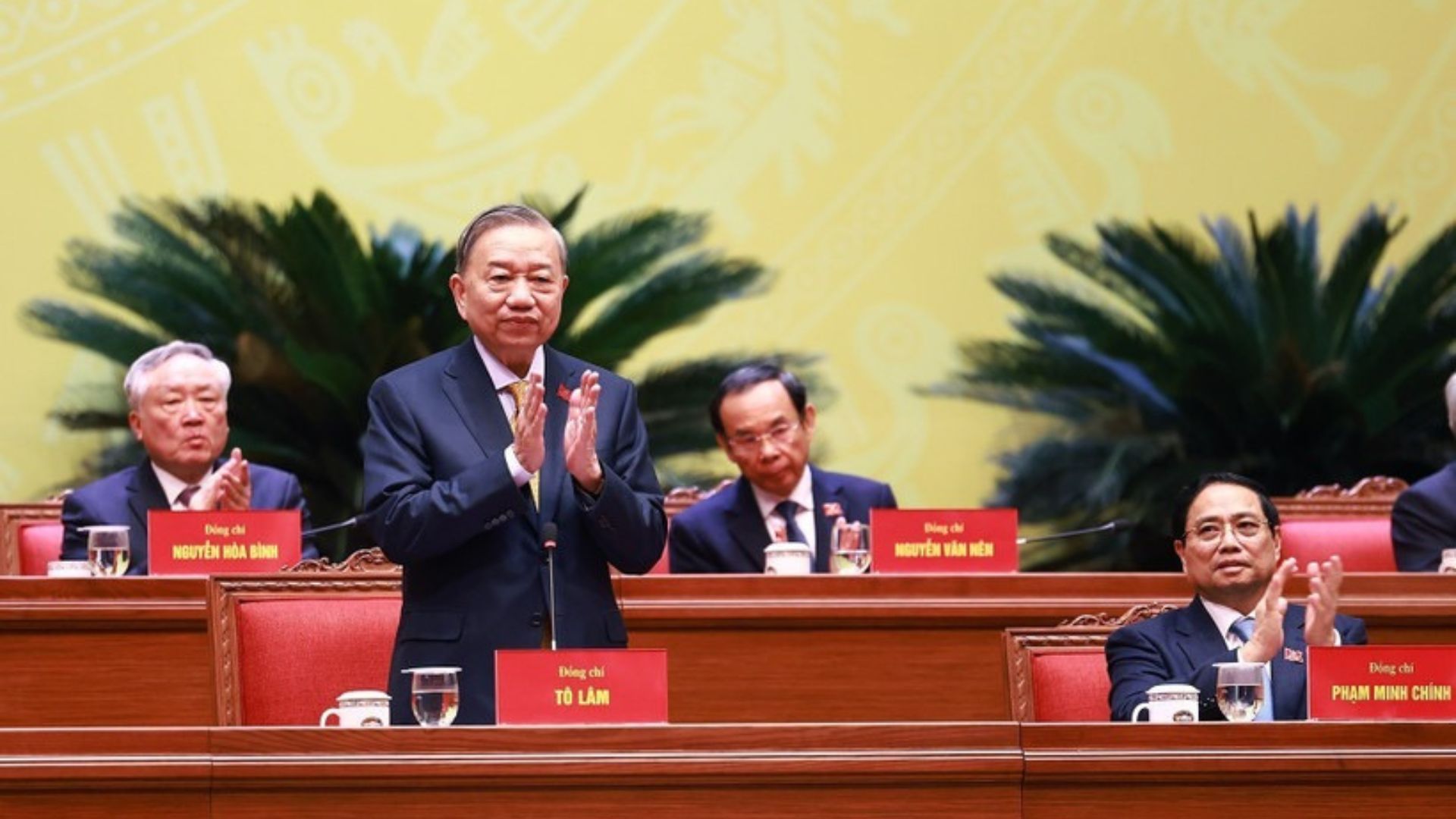


In the annals of the Communist Party of Vietnam (CPV), each general secretary embodies a defining phase in the state’s journey - be it revolutionary consolidation, post-war reconstruction, economic liberalization, or the construction of a legal-state framework. But To Lam inherits a mandate at a juncture more intricate than any faced by his predecessors. Challenges are abundant, including geopolitical fragmentation, rapid technological transformation, environmental pressures, and rising public expectations of state performance.
But Lam is determined to transform Vietnam into an “era of national rise.” In his speeches, he has underlined “urgency” and “decisiveness,” repeatedly calling for determination, rapid action, responsibility, and a sense of “time does not wait.”
Lam exhibits an image that combines technocratic vision and long-view statecraft. He has pursued a developmental paradigm upheld by efforts to buttress the centrality of the CPV while expanding institutional performance and local adaptiveness. The CPV has stepped up campaigns on cracking down on administrative friction, reducing backlog in permitting and digitizing services, as well as investing in administrative training and meritocracy.
This shift is discernible considering Lam’s resolute pivot from ideological consolidation to institutional innovation. While his predecessor, Nguyen Phu Trong, prioritized doctrinal cohesion and the CPV’s internal reforms, Lam is reshaping the CPV towards pragmatism-based reforms. He directed a crusade to merge cities and provinces to streamline governance and local bureaucracy to boost the political system’s efficiency, and empower local authorities with decision-making power.
The administrative reform is paired with public-sector reform. While being responsible for citizen affairs, commune-level officials are required to resolve issues swiftly and transparently. At the same time, civil servants must meet performance-based demand, supported by new digital platforms, such as VneID – Vietnamese electronic identification and authentication system – that track progress in real-time.
The administrative overhaul spearheaded by Lam proves both crucial and timely as Vietnam’s export-led model is reaching a point where institutional quality, not just investment capital or labor supply, will determine the next leap forward. Vietnam must also compete for high-value investment, navigate complex trade realignments and build a system that inspires trust, agility and foresight.
The country now enters a redefined global playing field. Global investors are increasingly seeking destinations that combine cheap labor, reliability, policy predictability, sustainable supply chains, legal transparency, and institutional resilience. Enhancing economic and institutional competitiveness thus becomes a prerequisite, as Vietnam is seeking to attract suppliers and manufacturing companies.
Yet, institutional restructuring may bring both risk and resistance. A large number of public servants have been affected by downsizing, relocation, or reclassification. Thousands of unemployed apparatchiks have found themselves redundant and uncertain about their future, as they lack the readiness and skills needed to secure new employment outside the public sector. Even worse, most local authorities lack the capacity to absorb new and heavy responsibilities. Citizens, too, may grow frustrated if changes are not felt quickly or fairly. The greatest danger is reform fatigue - or worse, reform reversal.
Reform can only prove meaningful if the apparatus is able to deliver on promises. As the government has merged administrative agencies, it must then ensure that local voices will not get drowned out. Clear mechanisms for citizen oversight and elected representation are crucial. During the planning process, binding rules should be issued, and residents should be looped in from day one to ensure local polls are not symbolic.
Beyond shuffling public servants through restructuring, the government should lift them up. Reskilling programs should be fair and inclusive, while being tailored to fit their skills and preferences. A national re-skilling framework requires customizing learning paths, providing financial support during transitions, and ensuring that veterans are supported by local agencies with grants to carry their careers forward.
In addition, decentralization isn’t devolution if it just dumps burdens on under-resources locals. Hence, the government should device clear-cut rules and operational guidelines on who is acceptable for what, and monetary support that sticks to the results. In short, resource allocations must be measurable through trackable targets.
Vietnam’s digital push, which pivoting transparency, can’t just stop at dumping data online. Rather, the efficiency requires citizen feedback. In other words, it should tweak policies on the fly from boots-on-the-ground feedback, as this allows for real-time policy adjustment. The government had better roll out a national digital dashboard displaying service indicators, such as clinic wait times or road repair scores. Open channels for citizen scoring and complaints can be supported by applications, through which people can rate, gripe, and suggest vote for authorities’ performance and improvements.
Above all, the CPV must treat reform like a long game. This demands political resolve, sharp policy chops, and an administrative machinery wired for continuous tweaking and adaptiveness. Long-term success rides on servant-leaders whose legitimacy and trust are earned from performance and results, not merely rhetorics or promises. In short, success will hinge on Lam and his team’s capability to strengthen the social contract through competence rather than slogans.
Huynh Ho Dai Nghia is a lecturer at the Faculty of History and International Relations, Ho Chi Minh City-University of Social Sciences and Humanities, Vietnam National University. His research focuses on public policy and contemporary international relations, particularly on how states formulate development strategies amid geopolitical rivalry.
Huynh Tam Sang is founder and editor-in-chief of the Vietnam Strategic Forum.
In the annals of the Communist Party of Vietnam (CPV), each general secretary embodies a defining phase in the state’s journey - be it revolutionary consolidation, post-war reconstruction, economic liberalization, or the construction of a legal-state framework. But To Lam inherits a mandate at a juncture more intricate than any faced by his predecessors. Challenges are abundant, including geopolitical fragmentation, rapid technological transformation, environmental pressures, and rising public expectations of state performance.
But Lam is determined to transform Vietnam into an “era of national rise.” In his speeches, he has underlined “urgency” and “decisiveness,” repeatedly calling for determination, rapid action, responsibility, and a sense of “time does not wait.”
Lam exhibits an image that combines technocratic vision and long-view statecraft. He has pursued a developmental paradigm upheld by efforts to buttress the centrality of the CPV while expanding institutional performance and local adaptiveness. The CPV has stepped up campaigns on cracking down on administrative friction, reducing backlog in permitting and digitizing services, as well as investing in administrative training and meritocracy.
This shift is discernible considering Lam’s resolute pivot from ideological consolidation to institutional innovation. While his predecessor, Nguyen Phu Trong, prioritized doctrinal cohesion and the CPV’s internal reforms, Lam is reshaping the CPV towards pragmatism-based reforms. He directed a crusade to merge cities and provinces to streamline governance and local bureaucracy to boost the political system’s efficiency, and empower local authorities with decision-making power.
The administrative reform is paired with public-sector reform. While being responsible for citizen affairs, commune-level officials are required to resolve issues swiftly and transparently. At the same time, civil servants must meet performance-based demand, supported by new digital platforms, such as VneID – Vietnamese electronic identification and authentication system – that track progress in real-time.
The administrative overhaul spearheaded by Lam proves both crucial and timely as Vietnam’s export-led model is reaching a point where institutional quality, not just investment capital or labor supply, will determine the next leap forward. Vietnam must also compete for high-value investment, navigate complex trade realignments and build a system that inspires trust, agility and foresight.
The country now enters a redefined global playing field. Global investors are increasingly seeking destinations that combine cheap labor, reliability, policy predictability, sustainable supply chains, legal transparency, and institutional resilience. Enhancing economic and institutional competitiveness thus becomes a prerequisite, as Vietnam is seeking to attract suppliers and manufacturing companies.
Yet, institutional restructuring may bring both risk and resistance. A large number of public servants have been affected by downsizing, relocation, or reclassification. Thousands of unemployed apparatchiks have found themselves redundant and uncertain about their future, as they lack the readiness and skills needed to secure new employment outside the public sector. Even worse, most local authorities lack the capacity to absorb new and heavy responsibilities. Citizens, too, may grow frustrated if changes are not felt quickly or fairly. The greatest danger is reform fatigue - or worse, reform reversal.
Reform can only prove meaningful if the apparatus is able to deliver on promises. As the government has merged administrative agencies, it must then ensure that local voices will not get drowned out. Clear mechanisms for citizen oversight and elected representation are crucial. During the planning process, binding rules should be issued, and residents should be looped in from day one to ensure local polls are not symbolic.
Beyond shuffling public servants through restructuring, the government should lift them up. Reskilling programs should be fair and inclusive, while being tailored to fit their skills and preferences. A national re-skilling framework requires customizing learning paths, providing financial support during transitions, and ensuring that veterans are supported by local agencies with grants to carry their careers forward.
In addition, decentralization isn’t devolution if it just dumps burdens on under-resources locals. Hence, the government should device clear-cut rules and operational guidelines on who is acceptable for what, and monetary support that sticks to the results. In short, resource allocations must be measurable through trackable targets.
Vietnam’s digital push, which pivoting transparency, can’t just stop at dumping data online. Rather, the efficiency requires citizen feedback. In other words, it should tweak policies on the fly from boots-on-the-ground feedback, as this allows for real-time policy adjustment. The government had better roll out a national digital dashboard displaying service indicators, such as clinic wait times or road repair scores. Open channels for citizen scoring and complaints can be supported by applications, through which people can rate, gripe, and suggest vote for authorities’ performance and improvements.
Above all, the CPV must treat reform like a long game. This demands political resolve, sharp policy chops, and an administrative machinery wired for continuous tweaking and adaptiveness. Long-term success rides on servant-leaders whose legitimacy and trust are earned from performance and results, not merely rhetorics or promises. In short, success will hinge on Lam and his team’s capability to strengthen the social contract through competence rather than slogans.
Huynh Ho Dai Nghia is a lecturer at the Faculty of History and International Relations, Ho Chi Minh City-University of Social Sciences and Humanities, Vietnam National University. His research focuses on public policy and contemporary international relations, particularly on how states formulate development strategies amid geopolitical rivalry.
Huynh Tam Sang is founder and editor-in-chief of the Vietnam Strategic Forum.
Từ khoá: To Lam Vietnam the Communist Party of Vietnam era of national rise