The Paradox of Suffering: When the End of a Painless World Marks the Birth of Dystopia
“Pain and suffering are always inevitable for a large intelligence and a deep heart.” — Fyodor Dostoevsky, Crime and Punishment


Human beings, from the ancient dreams of the Garden of Eden to the rational blueprints of the modern age, have always cherished a yearning to escape suffering and, more profoundly, to transcend the imperfect destiny of the human condition. Such yearning both uplifts the human spirit and breeds the seeds of tragedy. Entering the twentieth century, when the support of technology and modern reason bestowed upon humankind the illusion of possessing the power to control its own fate, writers with acute sensation such as H. G. Wells and George Orwell began to perceive the danger of the birth of dystopian worlds, where the dream of eliminating suffering becomes reality. From there, a paradox emerges: humanity knows to hope for better worlds precisely because of suffering; yet when suffering disappears, it is also the moment humankind loses itself in its fullest sense. This essay thus raises two questions: How does humanity’s dream of a painless utopia, over time, turn into dystopia? And in the contemporary era, are there seeds of a dystopia where humans attempt to eradicate suffering?
This essay states that utopia is born out of the desire to erase suffering, yet a world without suffering is not necessarily a utopia. In addition, I will analyze how suffering in contemporary life is manipulated by post-capitalism to assess whether there are any signs suggesting that a dystopia might be emerging, as the novels of the previous century foretold.
Suffering “is proposed to be defined as an unpleasant or even anguishing experience, severely affecting a person at a psychophysical and existential level” (Bueno-Gómez 1). The origins of suffering are diverse, it may arise from “social problems such as poverty or social exclusion, or from existential and personal problems like grief, stress” (Bueno-Gómez 2) and physical pain. The pursuit of a utopia free of suffering reflects a deep human longing to overcome finitude, impermanence, and vulnerability, both in lived reality and in the very essence of human existence. Paradoxically, suffering is a universal human experience tied to existence itself, and it is through its reminder of life’s finitude and imperfection that humans learn to hope, cultivate empathy, and move toward humanistic values, thus preserving their humanity (Featherstone 333). The dialectical relation between suffering and human existence is clearly reflected in Luciente’s words in Woman on the Edge of Time: “But, Connie, some problems you solve only if you stop being human, become metal, plastic, robot computers” (Piercy 118).
The dream of a utopia without suffering is inseparable from and transforms with the historical evolution of humankind. Since ancient times, the dream of transcending suffering has appeared in the earliest mythic tales of the golden ages or the Garden of Eden. Lyman Tower Sargent calls these “Body utopias” (10), where humans escape the suffering of birth, aging, sickness, death, or the horrors of war, disease, hunger; they do not labor and live in a state of absolute plenitude.
By the time of Plato and Thomas More, the utopian dream had shifted from relying on the abundance of nature to the self-construction of an ideal society through reason, law, and human-devised order. This marked the rise of organizing reason. For Plato, suffering arises from human finitude and the lower drives of the body. The Republic embodies the belief in eliminating suffering through submission to reason and law by means of “exercise of reason and control of the lower drives of the body, including lust, greed and envy” (Featherstone 338). Then came Thomas More with his Utopia, envisioning a community operated through justice, labor, and institutions. In this world, the abolition of money, simple living, and the elevation of reason to control desire and discipline would produce an ideal society. Yet both Plato and More reveal tendencies toward homogenization and control. When an absolute framework of reason and discipline is imposed upon every individual for uniform practice, the individual also eliminates their capacity for emotion and inner freedom. Classical utopia thus unintentionally laid the groundwork for totalitarian ideas that later gave birth to the dystopias of the twentieth century.
When the industrial era began to unfold in England in the eighteenth century, many artists were deeply unsettled and harbored ominous forebodings of a new, deadly order poised to engulf society. The expansion of industrialization not only generated economic inequality and eroded social values; it also drove humanity into a hell of bottomless desire, propelled by rapid technological advances. By the twentieth century, when organizing reason had reached its extreme with the aid of science and technology, writers like Huxley and Orwell echoed and extended this anxiety. Brave New World and 1984 are not mere works of fiction; they are echoes of reality that simultaneously open doors to impossible worlds directly connected to realities. In those worlds, the dream of a place without suffering is reborn in a distorted form, where humans confidently believe they can control suffering through technological means. The arrogance of modern humans nourishes an illusion that they can intervene in and modulate everything according to their will, with suffering also being just a pawn. As in the works of Orwell and Huxley, the elimination or transformation of suffering is a step they take toward the interest of control and social stability for the elite.
In Brave New World, suffering is taboo and meticulously eliminated from its roots through biotechnology and behavioral psychology. Every manifestation of suffering - material or metaphysical, personal or social - has a prescribed solution. From incubation rooms to upbringing, humans are designed and conditioned by hypnopaedia from newborn age to suit their social function, freed from pressure or discontent. By adulthood, the threats of aging, illness, and troubled relationships are already neutralized and replaced by hedonism and shallow materialism. The elite’s calculation is so refined that they invent soma, accompanied by the slogan “A gramme is better than a damn,” to suppress spontaneous eruptions of sorrow or despair that may arise unpredictably. This is a world without financial worries and class conflict. Every position and class has already been programmed with its own features, duties, and distinct needs, so as to ensure that no uprising would ever occur. Everyone believes that “Everyone belongs to everyone else,” and each is at peace doing their own work. It is indeed a stable society but one must ask if it is a place fit for human life. John’s cry for “the right to be unhappy” turns the logic inside out: happiness becomes a life sentence, while the experience of suffering becomes a right one must claim if one still wishes to remain human in the fullest sense.
Two decades later, George Orwell constructed 1984 as the absolute counterpoint to Brave New World. Though both serve the interests of power, if the inhumanity of Brave New World lies in its total elimination of suffering through infinite pleasure, then that of 1984 lies in recreating suffering through terror, fear, and insecurity as tools to maintain the Party’s absolute power. The Party suppresses all human positive emotions, only rage and horror can exist. Suffering and humiliation are used to “tear human minds to pieces and put them together again in new shapes of your own choosing” (Orwell 293), as O’Brien explains to Winston. In that society, people are immersed in pools of torment and suffering that generate perverted forms of happiness: Parson feels proud for being betrayed by his seven-year-old daughter; children are disappointed if denied the spectacle of a hanging; crowds revel in collective frenzy and hatred. In this society, suffering in terms of economy and everyday life is blurred into manipulation by the Party to paralyze class conflict: deliberate material scarcity caused by war; constant fake news and propaganda; the fear of surveillance and punishment that brainwashes them and prevents them from grasping reality.
Winston, in such a world, still feels anguish and resistance. His effort to preserve memory, love, empathy, private thought, even the suffering of losing them, makes him a source of light in the novel. Yet he cannot defeat the Party’s cunning mastery in exploiting primal fear and pain to annihilate humanity. In Room 101, where the Party wields rats, the totem of primal fear, to trigger the most primitive instinct for survival, Winston loses all capacity for love and moral awareness, feeling only the terrified pain of a trapped animal. Here, metaphysical suffering is trampled and degraded into sheer reflex of fear, the Party’s ultimate weapon of dehumanization. Winston like everyone else is flattened, left to live in the pain of a beast before the whip.
The two novels thus reveal divergent tragedies born from opposing extremes in dealing with suffering: one absorbs it through pleasure to abolish it entirely; the other amplifies it to make pain mere control. Both tendencies lead to the objectification of humankind and the end of humanity itself. This is the paradox of suffering, its presence in daily life may weary and devastate us, yet any attempt to erase it by extreme means shatters the human world.
In the capitalist era we are living in, suffering has become much more difficult to detect and define. We are living in a time that, according to Deleuze, is a society of control, where confinement, violence, or inequality are secretly controlled through technology and fake satisfaction. Under the expanding mechanism of post-industrial and neoliberalism, values and discourses are continuously deconstructed and reconstructed to serve capitalist interests.
Due to this context, human beings no longer even know which suffering they should fight for. Our time gathers all the extreme elements appearing in the literary works we have discussed but in a more sophisticated way because it maintains the condition that Zygmunt Bauman calls liquid modernity, where all control takes place in the artificial free flow of convenience and consumption.
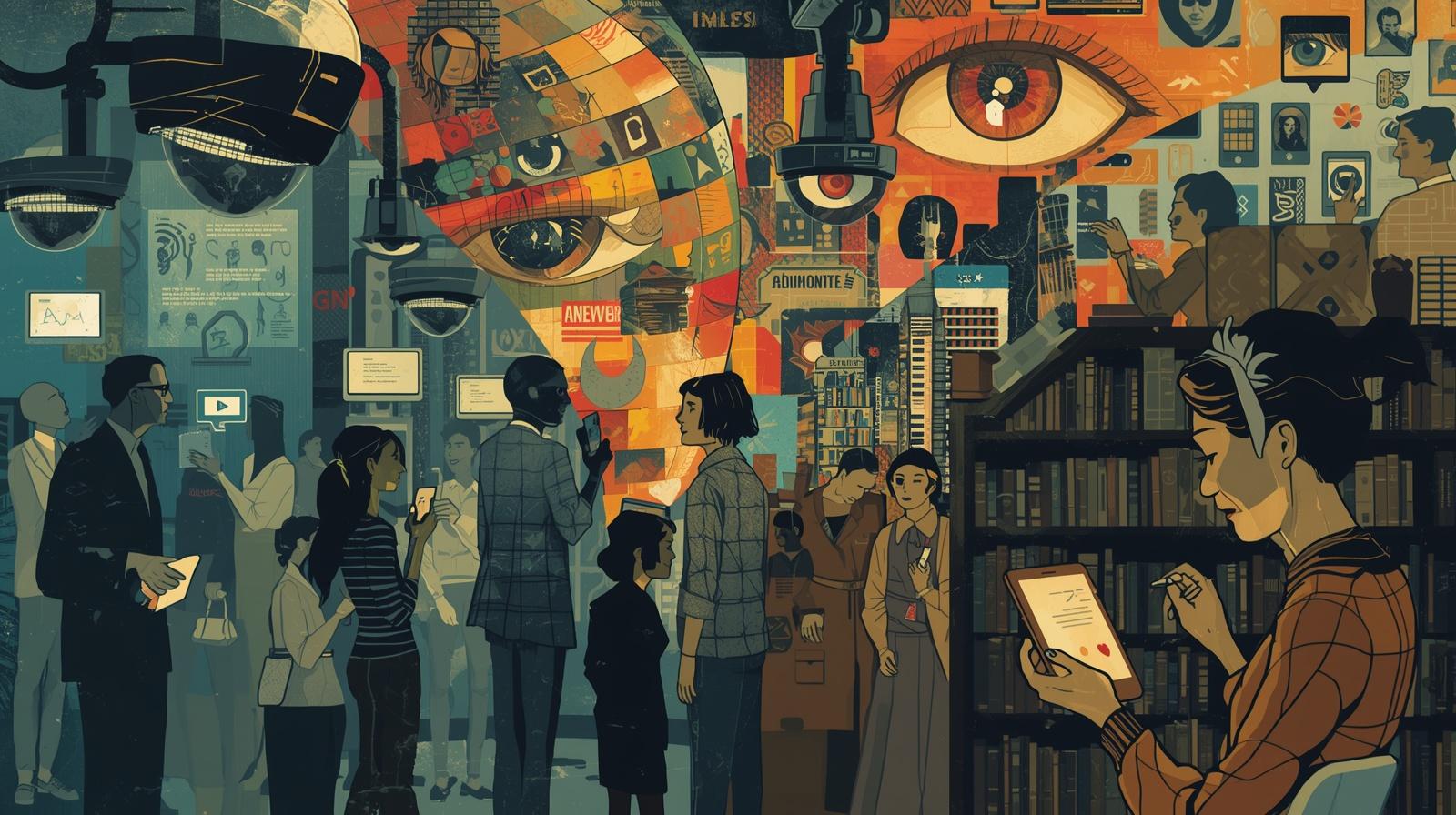
Like in Brave New World, we produce derivatives of soma as various stimulants, reels of entertainment as infinite scrolls generating instant dopamine,… a series of manifestations forcing us to entertain ourselves to death. Society has even been able to intervene in the evolutionary process so that human beings are no longer haunted by suffering from the existential cycle. For instance, operating rooms can help people stretch their skin, modify to remain forever young. And just like in the society of 1984, we are constantly controlled when every heartbeat, step, or fingerprint is stored, monitored, and adjusted by the machines around us; information, history, and truth are manipulated every second by the supreme power of the media – people today may cry for Palestine but only one week later they will forget the suffering of genocide because information piles up endlessly, they fall into surcharge of reality and are thrown out of history.
All of it aims to push us away from the human essence in order to serve the sole purpose of turning human beings into profit-producing tools of capitalism. Perhaps the world we are living in has already been a dystopia; the question about a seed of dystopia in the effort to eliminate suffering, as I raised in the second question, is perhaps no longer as essential as the fact that we must once again redefine suffering so that from there new pathways can be built from the vision of utopia – suffering – dystopia that is true to our time. We must know whom or what we want to fight, for suffering and because of suffering; which worst-case scenario will occur because the world we live in no longer has a tangible source of suffering, a sole supreme boss, a single supreme State, when behind one horizon of power there is another higher horizon of power - the Alpha Plus Plus who do not reveal themselves in Brave New World, the powers existing in complex forms behind Big Brother’s poster. Our condition, according to Kafka, is the condition of a beast that “wrests the whip from its master and whips itself to become master, and does not know that this is only a fantasy produced by a new knot in the master’s whiplash” (23).
Works Cited
Bueno-Gómez, Noelia. “Conceptualizing Suffering and Pain.” Philosophy, Ethics, and Humanities in Medicine, vol. 12, no. 7, 2017, pp. 1–11.
Deleuze, Gilles. “Postscript on the Societies of Control.” October, vol. 59, Winter 1992, pp. 3-7.
Featherstone, Mike. “The Tragedy of Utopia in the Age of the Anthropocene: Beyond Dystopia, Despair and Catastrophic Futures.” European Journal of Social Theory, vol. 27, no. 2, 2024, pp. 332–351.
Kafka, Franz. The Zürau Aphorisms. Translated by Ernst Kaiser and Eithne Wilkins, edited by Max Brod, Schocken Books, 1971.
Orwell, George. 1984. Valley Publishing House, 2021.
Piercy, Marge. Woman on the Edge of Time. Fawcett, 1985.
Sargent, Lyman Tower. “The Three Faces of Utopianism Revisited.” Utopian Studies, vol. 5, no. 1, 1994, pp. 1-37.
Human beings, from the ancient dreams of the Garden of Eden to the rational blueprints of the modern age, have always cherished a yearning to escape suffering and, more profoundly, to transcend the imperfect destiny of the human condition. Such yearning both uplifts the human spirit and breeds the seeds of tragedy. Entering the twentieth century, when the support of technology and modern reason bestowed upon humankind the illusion of possessing the power to control its own fate, writers with acute sensation such as H. G. Wells and George Orwell began to perceive the danger of the birth of dystopian worlds, where the dream of eliminating suffering becomes reality. From there, a paradox emerges: humanity knows to hope for better worlds precisely because of suffering; yet when suffering disappears, it is also the moment humankind loses itself in its fullest sense. This essay thus raises two questions: How does humanity’s dream of a painless utopia, over time, turn into dystopia? And in the contemporary era, are there seeds of a dystopia where humans attempt to eradicate suffering?
This essay states that utopia is born out of the desire to erase suffering, yet a world without suffering is not necessarily a utopia. In addition, I will analyze how suffering in contemporary life is manipulated by post-capitalism to assess whether there are any signs suggesting that a dystopia might be emerging, as the novels of the previous century foretold.
Suffering “is proposed to be defined as an unpleasant or even anguishing experience, severely affecting a person at a psychophysical and existential level” (Bueno-Gómez 1). The origins of suffering are diverse, it may arise from “social problems such as poverty or social exclusion, or from existential and personal problems like grief, stress” (Bueno-Gómez 2) and physical pain. The pursuit of a utopia free of suffering reflects a deep human longing to overcome finitude, impermanence, and vulnerability, both in lived reality and in the very essence of human existence. Paradoxically, suffering is a universal human experience tied to existence itself, and it is through its reminder of life’s finitude and imperfection that humans learn to hope, cultivate empathy, and move toward humanistic values, thus preserving their humanity (Featherstone 333). The dialectical relation between suffering and human existence is clearly reflected in Luciente’s words in Woman on the Edge of Time: “But, Connie, some problems you solve only if you stop being human, become metal, plastic, robot computers” (Piercy 118).
The dream of a utopia without suffering is inseparable from and transforms with the historical evolution of humankind. Since ancient times, the dream of transcending suffering has appeared in the earliest mythic tales of the golden ages or the Garden of Eden. Lyman Tower Sargent calls these “Body utopias” (10), where humans escape the suffering of birth, aging, sickness, death, or the horrors of war, disease, hunger; they do not labor and live in a state of absolute plenitude.
By the time of Plato and Thomas More, the utopian dream had shifted from relying on the abundance of nature to the self-construction of an ideal society through reason, law, and human-devised order. This marked the rise of organizing reason. For Plato, suffering arises from human finitude and the lower drives of the body. The Republic embodies the belief in eliminating suffering through submission to reason and law by means of “exercise of reason and control of the lower drives of the body, including lust, greed and envy” (Featherstone 338). Then came Thomas More with his Utopia, envisioning a community operated through justice, labor, and institutions. In this world, the abolition of money, simple living, and the elevation of reason to control desire and discipline would produce an ideal society. Yet both Plato and More reveal tendencies toward homogenization and control. When an absolute framework of reason and discipline is imposed upon every individual for uniform practice, the individual also eliminates their capacity for emotion and inner freedom. Classical utopia thus unintentionally laid the groundwork for totalitarian ideas that later gave birth to the dystopias of the twentieth century.
When the industrial era began to unfold in England in the eighteenth century, many artists were deeply unsettled and harbored ominous forebodings of a new, deadly order poised to engulf society. The expansion of industrialization not only generated economic inequality and eroded social values; it also drove humanity into a hell of bottomless desire, propelled by rapid technological advances. By the twentieth century, when organizing reason had reached its extreme with the aid of science and technology, writers like Huxley and Orwell echoed and extended this anxiety. Brave New World and 1984 are not mere works of fiction; they are echoes of reality that simultaneously open doors to impossible worlds directly connected to realities. In those worlds, the dream of a place without suffering is reborn in a distorted form, where humans confidently believe they can control suffering through technological means. The arrogance of modern humans nourishes an illusion that they can intervene in and modulate everything according to their will, with suffering also being just a pawn. As in the works of Orwell and Huxley, the elimination or transformation of suffering is a step they take toward the interest of control and social stability for the elite.
In Brave New World, suffering is taboo and meticulously eliminated from its roots through biotechnology and behavioral psychology. Every manifestation of suffering - material or metaphysical, personal or social - has a prescribed solution. From incubation rooms to upbringing, humans are designed and conditioned by hypnopaedia from newborn age to suit their social function, freed from pressure or discontent. By adulthood, the threats of aging, illness, and troubled relationships are already neutralized and replaced by hedonism and shallow materialism. The elite’s calculation is so refined that they invent soma, accompanied by the slogan “A gramme is better than a damn,” to suppress spontaneous eruptions of sorrow or despair that may arise unpredictably. This is a world without financial worries and class conflict. Every position and class has already been programmed with its own features, duties, and distinct needs, so as to ensure that no uprising would ever occur. Everyone believes that “Everyone belongs to everyone else,” and each is at peace doing their own work. It is indeed a stable society but one must ask if it is a place fit for human life. John’s cry for “the right to be unhappy” turns the logic inside out: happiness becomes a life sentence, while the experience of suffering becomes a right one must claim if one still wishes to remain human in the fullest sense.
Two decades later, George Orwell constructed 1984 as the absolute counterpoint to Brave New World. Though both serve the interests of power, if the inhumanity of Brave New World lies in its total elimination of suffering through infinite pleasure, then that of 1984 lies in recreating suffering through terror, fear, and insecurity as tools to maintain the Party’s absolute power. The Party suppresses all human positive emotions, only rage and horror can exist. Suffering and humiliation are used to “tear human minds to pieces and put them together again in new shapes of your own choosing” (Orwell 293), as O’Brien explains to Winston. In that society, people are immersed in pools of torment and suffering that generate perverted forms of happiness: Parson feels proud for being betrayed by his seven-year-old daughter; children are disappointed if denied the spectacle of a hanging; crowds revel in collective frenzy and hatred. In this society, suffering in terms of economy and everyday life is blurred into manipulation by the Party to paralyze class conflict: deliberate material scarcity caused by war; constant fake news and propaganda; the fear of surveillance and punishment that brainwashes them and prevents them from grasping reality.
Winston, in such a world, still feels anguish and resistance. His effort to preserve memory, love, empathy, private thought, even the suffering of losing them, makes him a source of light in the novel. Yet he cannot defeat the Party’s cunning mastery in exploiting primal fear and pain to annihilate humanity. In Room 101, where the Party wields rats, the totem of primal fear, to trigger the most primitive instinct for survival, Winston loses all capacity for love and moral awareness, feeling only the terrified pain of a trapped animal. Here, metaphysical suffering is trampled and degraded into sheer reflex of fear, the Party’s ultimate weapon of dehumanization. Winston like everyone else is flattened, left to live in the pain of a beast before the whip.
The two novels thus reveal divergent tragedies born from opposing extremes in dealing with suffering: one absorbs it through pleasure to abolish it entirely; the other amplifies it to make pain mere control. Both tendencies lead to the objectification of humankind and the end of humanity itself. This is the paradox of suffering, its presence in daily life may weary and devastate us, yet any attempt to erase it by extreme means shatters the human world.
In the capitalist era we are living in, suffering has become much more difficult to detect and define. We are living in a time that, according to Deleuze, is a society of control, where confinement, violence, or inequality are secretly controlled through technology and fake satisfaction. Under the expanding mechanism of post-industrial and neoliberalism, values and discourses are continuously deconstructed and reconstructed to serve capitalist interests.
Due to this context, human beings no longer even know which suffering they should fight for. Our time gathers all the extreme elements appearing in the literary works we have discussed but in a more sophisticated way because it maintains the condition that Zygmunt Bauman calls liquid modernity, where all control takes place in the artificial free flow of convenience and consumption.
Like in Brave New World, we produce derivatives of soma as various stimulants, reels of entertainment as infinite scrolls generating instant dopamine,… a series of manifestations forcing us to entertain ourselves to death. Society has even been able to intervene in the evolutionary process so that human beings are no longer haunted by suffering from the existential cycle. For instance, operating rooms can help people stretch their skin, modify to remain forever young. And just like in the society of 1984, we are constantly controlled when every heartbeat, step, or fingerprint is stored, monitored, and adjusted by the machines around us; information, history, and truth are manipulated every second by the supreme power of the media – people today may cry for Palestine but only one week later they will forget the suffering of genocide because information piles up endlessly, they fall into surcharge of reality and are thrown out of history.
All of it aims to push us away from the human essence in order to serve the sole purpose of turning human beings into profit-producing tools of capitalism. Perhaps the world we are living in has already been a dystopia; the question about a seed of dystopia in the effort to eliminate suffering, as I raised in the second question, is perhaps no longer as essential as the fact that we must once again redefine suffering so that from there new pathways can be built from the vision of utopia – suffering – dystopia that is true to our time. We must know whom or what we want to fight, for suffering and because of suffering; which worst-case scenario will occur because the world we live in no longer has a tangible source of suffering, a sole supreme boss, a single supreme State, when behind one horizon of power there is another higher horizon of power - the Alpha Plus Plus who do not reveal themselves in Brave New World, the powers existing in complex forms behind Big Brother’s poster. Our condition, according to Kafka, is the condition of a beast that “wrests the whip from its master and whips itself to become master, and does not know that this is only a fantasy produced by a new knot in the master’s whiplash” (23).
Works Cited
Bueno-Gómez, Noelia. “Conceptualizing Suffering and Pain.” Philosophy, Ethics, and Humanities in Medicine, vol. 12, no. 7, 2017, pp. 1–11.
Deleuze, Gilles. “Postscript on the Societies of Control.” October, vol. 59, Winter 1992, pp. 3-7.
Featherstone, Mike. “The Tragedy of Utopia in the Age of the Anthropocene: Beyond Dystopia, Despair and Catastrophic Futures.” European Journal of Social Theory, vol. 27, no. 2, 2024, pp. 332–351.
Kafka, Franz. The Zürau Aphorisms. Translated by Ernst Kaiser and Eithne Wilkins, edited by Max Brod, Schocken Books, 1971.
Orwell, George. 1984. Valley Publishing House, 2021.
Piercy, Marge. Woman on the Edge of Time. Fawcett, 1985.
Sargent, Lyman Tower. “The Three Faces of Utopianism Revisited.” Utopian Studies, vol. 5, no. 1, 1994, pp. 1-37.
Từ khoá: dystopia utopia suffering technology 1984 George Orwell Brave New World